
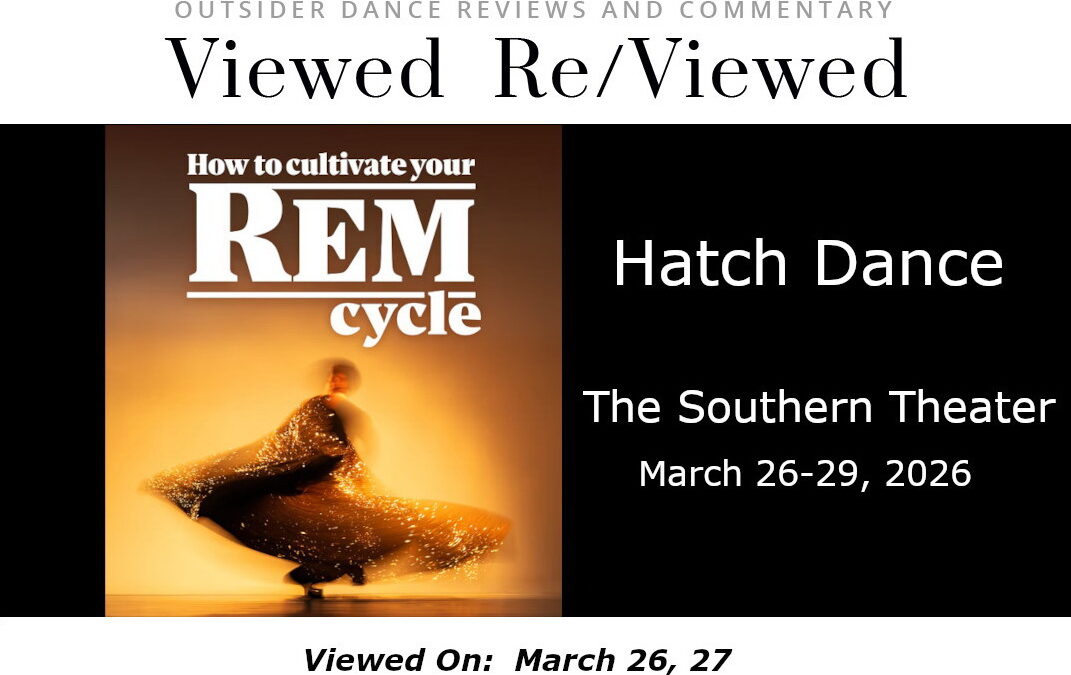
Company: Hatch Dance
Choreographer: Helen Hatch
Production: Helen Hatch with Jon Ferguson
Performers: Artemis Brown, Joe Tennis, Juliana Johnson, Connor Simone, Emily Trapnell – with: Barbara Berlovitz, Malia Gorman-Carter, Noelle Jackson, Kaitelin Dambrine
Experimental works are famously difficult to evaluate because, by definition, they defy easy categorization. Theme-based works are, if anything, more difficult to evaluate because of the overpowering urge to determine how effectively that theme was explored rather than focus on the quality of the artistry involved and whether or not the audience was moved by that effort.
How to Cultivate Your REM Cycle – a title slightly too long for a theater marquee, easily belonged in both categories. It was both experimental (to which I would add high concept) and it relentlessly, if quixotically, probed the complexities of sleep, a theme which was simultaneously easily identifiable and frustratingly intangible. Fortunately for me, my criteria for evaluating this somewhat bewildering, multifaceted performance was reduced to something quite simple: Did I and my fellow audience members find it – not just unique and interesting, but rewarding? Did the aura of the performance linger, long after walking out of the theater – making the ticket price irrelevant? Fortunately, the answer this evening was – yes to both.
Hatch Dance, with choreographer Helen Hatch and theatrical collaborator Jon Ferguson, undertook an open-ended exploration of the nature of sleep and dreams, suffused with the pernicious nature of sleeplessness – a dramatic enactment of this human necessity confronted with its frustrating, dangerous absence. This was a risky, ambitious, artistic endeavor that started barely tethered to a kernel of an idea and somehow morphed into the sprawling, multifaceted performance I saw on opening night. I then saw it again the next evening, trying to connect the dots, or, considering the pointlessness of finding logical correlations in an extended dreamscape, at least identify and try to remember the many facets of this production.
This review is not a blow-by-blow recreation of the event. If you would like that, I strongly encourage you to see the production when, hopefully, it is staged again as this nascent work evolves. Rather, it’s an accumulation of impressions from the darkened seats – in the end, all that really matters to an audience.
One of the most lasting of those impressions was a kinetic set piece that was active before the show began. Upstage center, under the proscenium arch of the Southern Theater, was a very large, conical pile of sand, being fed by a thin but continuous rivulet of sand from some unseen point high above and behind the battered, classic old arch. Lighting effects isolated what must have been a thirty-foot stream, individual grains flickering in the light during their endless descent. It was simple, dramatic, isolated, unexpected and unexplained. The effect was totally mesmerizing.
This intriguing mound, with its never-ending, sparkling stream, was a constant presence that dominated the set. Interactions with it throughout the program were sporadic and seemed incidental with no literal explanation. The implications weren’t that obscure – hourglass, sands of time, the sandman/sleep – all readily came to mind, but none of that was confirmed until a dramatic moment just before intermission when, who we now understand is The Dreamer character, grabs a handful of sand, and as it flows through his fingers, declares, “We’re running out of time!”- and the stream stops just before the set goes to black, silently transforming the moment into something profound and powerful. In the end, this prop became a silent, unattributed character. It was enigmatic, arresting, oddly satisfying and frankly, brilliant.
By thematically and physically engaging the act of dreaming, Hatch has issued herself a license to engage the surreal. Supported by her talented ensemble, we are treated to a circus of imaginative improbability. There is a lovely, balletic interlude where a dancer emerges on pointe, impressively large arrangements of daisies springing up from the shoulder pads on her long dress. This precedes what is to become an ongoing dreamscape. A female duet, defined by the rope-like bonds that force them to move in captive unison, was entirely unexpected. By the time a performer attempts to mount a short, unsupported ladder in mid-air, we are ready to accept it, as this is simply part of the world that Hatch has established and in which anything could happen. It’s a dream, and everything, however irrational, is connected to that premise and is therefore thematically legal. After all, she does have a license.
The surreal nature of the opening performed by the two principal characters – with its spasmodic interludes between total darkness and utterly different, vaguely frightening physical confrontations, seemed intentionally confusing. The world that it dropped us into was one of uncertainty, fear and danger – which quickly came to include the bizarre.
I learned, after the fact, through the inconvenience of the convenient QR code, that the program named the two principal characters The Sleeper and The Dreamer, I assume that was not arbitrary but neither was it sufficient for my understanding of their roles.
The Sleeper didn’t do much in the way of sleeping. As a performer, Artemis Brown was tasked with portraying a hapless everyman, locked in a mundane cycle which included everything from brushing his teeth to bizarre work reviews, all the while being submitted to an array of perplexing intrusions from The Dreamer. His situation, alternating between boredom and a kind of pathetic victimhood, was never clear to me. Was he the source of the surreal performances being acted out on stage? Were these his dreams made manifest or was he suffering because sleeplessness didn’t give him access to that release – the sleep-induced, dissociative REM state they represented? I had to remind myself that it was pointless to try to make literal sense of what was obviously a dreamscape and just experience the creativity inherent in all this randomness.
By contrast, The Dreamer represented a mysterious, highly engaging character. This volatile part was brilliantly performed by Joe Tennis, who was engaged in such a convoluted mix of dance, drama and dialogue that his role defied real description. His creative, seemingly spontaneous, dance solos were a delight to watch – but in his interactions with The Sleeper, I was immediately confused. Was he an adversary? An advocate? A sympathetic observer? A manipulator? An alter ego? In a subsequent talk-back session, it turned out he was all of these, with each being somewhat improvised on the spot. I was left unenlightened but at least satisfied I hadn’t misinterpreted what I was seeing and could suspend my insistence of consistent intention and simply respond to the impressive, free-form spontaneity of his performance.
To the extent that this is also a play, with actual speaking parts, the plot, if you could call it that, enjoys the same freedom from apparent logic. A dialogue-driven scene can simply emerge and disappear. One such instance, which should easily have been one of the least engaging of these spoken interludes, was also backdrop to one of the more unusual dance sequences. In this scene, the protagonist, The Sleeper, consistent with the mundane nature of his life, is miming one side of a phone conversation with his bank, navigating the endless phone tree and responding to various unheard prompts and voices on the other end, with much repetition and increasing frustration – “No, I don’t want to open an account”, insisting on speaking to a person – and frequently having to recite a long account number. Here, Ferguson has scripted a scene that is a study in banality, neither humorous nor dramatic and certainly the death of audience interest. Against this monotonous backdrop, without musical accompaniment, Hatch has set a trio of dancers whose bright, imaginative costumes and high energy contrast mightily with the stultifying dialogue. Of critical importance here is that they are obviously responding to his frustration and tailoring their movement in some way to his one-sided monologue. It isn’t literal, but it’s obviously connected and now there is a very interesting aesthetic at play. There is name for this.
If you haven’t experienced narrative dance (or been subjected to it – depending), let me assure you – it’s a thing. Various performers, wanting to explore dance beyond the traditional elements of rhythm and music, turn to spoken word. This could be almost anything from poetry recitation to a recorded lecture. The reason for many of these choices can defy all logic, and in my experience, the performance fails more often than it succeeds. A chant or rap can work because it has strong rhythmic structure, but straight narration can be really perplexing. From the perspective of the audience, our visual and auditory sensory inputs are presented with two tracks that our brains instinctively try to make sense of. With musical accompaniment, we preference the visuals of the movement, and feel, but don’t have to interpret, except perhaps on an emotional level, the musicality and rhythm of the score. But with narration, our brains are wired to cling to the words and try to extract meaning. Unfortunately, the audio is often (or usually) totally unrelated to the movement. Physically miming the words is the opposite of art, so when narrative dance is successful, the performer needs to find brief moments of connection where gesture and movement reflect or augment what is being spoken. It can and should be sporadic, but the touch-points need to be there in a way that we can feel and relate to, even subconsciously, providing us with a slender thread of recognition.
What I found intriguing here was that the audio was delivered by a live actor, not some disembodied voice – a real twist on the genre. Yet, somehow, in this sequence, Hatch managed to construct a through-line in a way that was both improbable and yet provided a connection to the piece. While this is entirely subjective, I felt that the performers were sporadically connecting to the emotional state of the speaker and somehow reflected the absurdity of the situation. A quick series of gestures during each of the lengthy recitations of the account number made me believe that it was some mysterious sign language representing digits. Random dots that somehow connected in my brain. I’ve seen a number of narrative dance sequences and this little theater of the absurd was not just odd, but oddly satisfying.
There is no element so mundane that it cannot become impactful and impressive if you just take it far enough. Doing a simple thing once is unremarkable. Do it ten thousand times and you are an acclaimed artist. With REM Cycle, it was something as simple as tossing a pillow in a program built around sleep – easily anticipated as an element and equally unremarkable. But then they tossed another, and another, and another, and another, and then continued that from different directions – seemingly forever – and now, suddenly, it was a thing.
And, significantly, there was no effort being made to recycle them – just an increasingly astonishing, endless supply of tossed, full-size bed pillows, replete with their white cases, being thrown with precision and, in the spirit of the self-destructive dialogue they were illustrating, harmful intent, at the hapless Sleeper – coming at him simultaneously from across stage, upstage and backstage at a furious pace until they accumulated into an ironically untranquil mountain of fluff – the last one delivered at close range, hitting the Sleeper with visible force and actual malice. The pillow, this soft, inviting harbinger of peaceful sleep, suddenly became something comically malevolent. I’m not convinced this was dance, but it was great theater.
With How to Cultivate Your REM Cycle, Helen Hatch and Jon Ferguson undertook an exploration of a profound and elusive subject – sleep. Their collaborative approach, which included the company, meant nothing less challenging than navigating between universal experience and the ultimately unknowable. Their vision demanded innovation, an acceptance of uncertainty and a fearless pursuit of the irrational, all the while bound to the demands of an aesthetic. In doing so, they used all the tools at their disposal – dance, theater, video projection, live music, creative costuming, dramatic lighting and innovative props – to create a multi-layered, multifaceted experience. The high level at which they executed these disparate, inherently unwieldy elements belied any uncertainty in the attempt to mount them, and was a testament to their experience and professionalism. The resulting production was constantly creative, giving us, in the audience, many memorable moments and a truly satisfying ending. Easily the most interesting thing I’ve seen in a very long while.
Viewed Re/Viewed
Recent Comments